 Dynasty Tales
Fuxi and the Eight Trigrams: Observing Nature and the Beginnings of Civilization
In the misty ancient world, how did Fuxi, a figure with a human head and a snake's body, study the stars and the patterns on a Dragon Horse to reveal nature's secrets and kindle the first sparks of civilization?
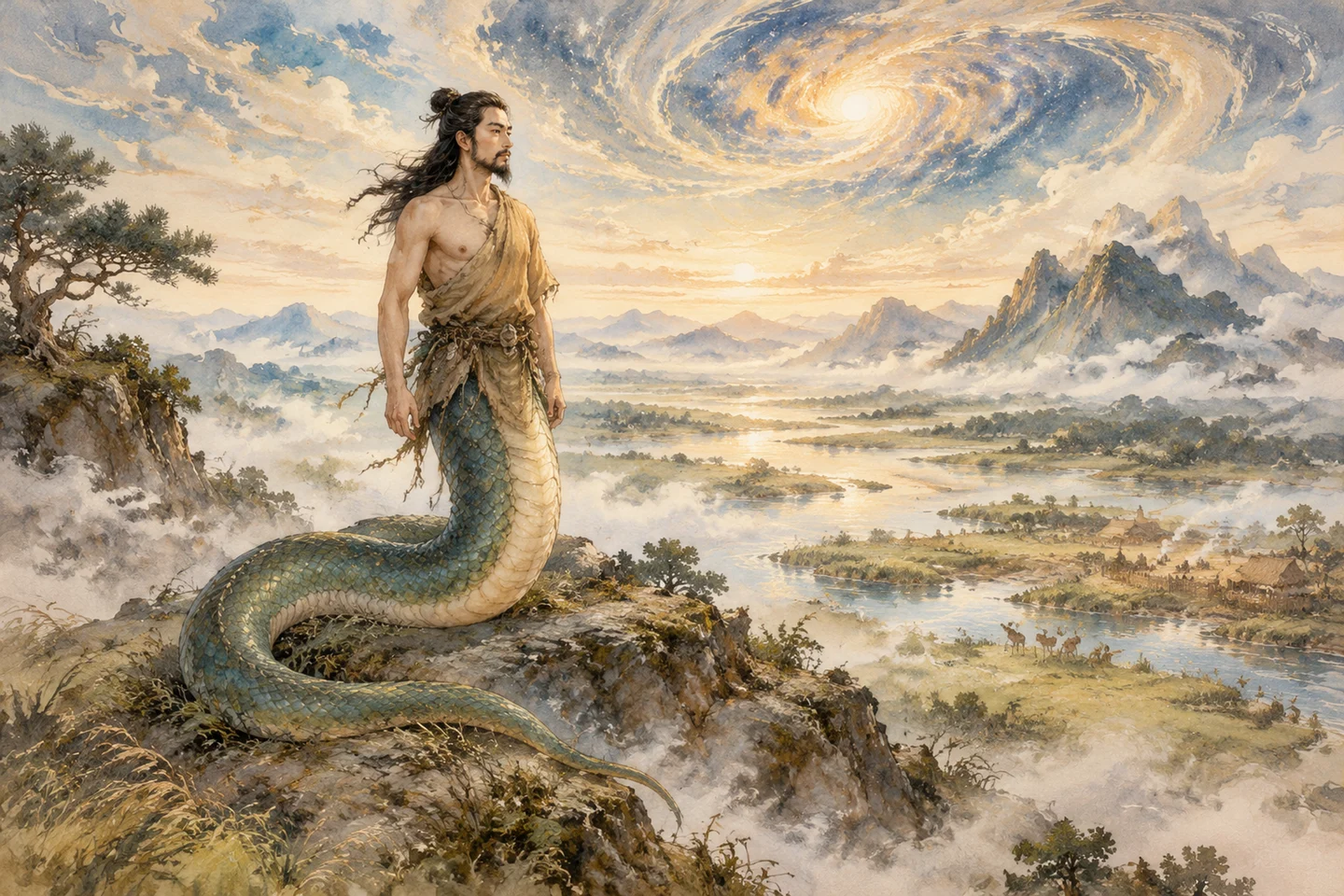
Who is Fuxi, and what are the Eight Trigrams?
Fuxi is a legendary Chinese culture hero associated with the Eight Trigrams, also called bagua. Each trigram has three lines, either solid or broken. Their different combinations represent natural forces and features, including heaven, earth, water and mountains.
In this retelling, a Dragon Horse helps inspire Fuxi’s patterns. Other episodes connect him with nets, keeping animals, marriage rites and music. These are origin legends, rather than proof that one historical person invented those practices. Read the overview and opening here, with the source notes below; the complete retelling is reserved for members. Membership purchases are not open yet.
Try this together: How many different three-line patterns can you make if each line can be solid or broken?
Read the opening
An old Chinese myth tells this story. A long, long time ago, in the ancient era, the world was shrouded in a hazy chaos. Back then, the earth did not look as it does now. People lived in a wild, desolate world, feeling strange and afraid of everything around them.
In this mysterious age, there was a marshland called Leize, where mist swirled all year round and the air was filled with natural magic. Fuxi's mother, Huaxu, was walking there when she accidentally stepped into a giant footprint, and soon after, she became pregnant. After twelve years of growth, Fuxi was born in Chengji. He was not only the first of the Three Sovereigns—the legendary first rulers of China—but also the cultural ancestor of the Chinese people.
🔒 Members-only story
Checking your membership…
Myth and source notes
Fuxi is a culture hero in Chinese myth. Taiping Yulan, chapter 78, and Yishi, chapter 3, collect traditions about his birth, the Eight Trigrams, nets, marriage rites, and music. The medicine section of Gujin Tushu Jicheng, chapter 539, quotes a tradition about herbs and nine needles; this is not evidence for a treatment. These texts preserve origin legends, not proof that one person invented all these things. The Dragon Horse scene and the sixty-four days are part of this retelling. Accounts give different numbers of strings for the se; thirty-five is retained here as a storytelling detail, not a verified instrument specification. The pictures are imaginative illustrations.
© 2026 Dynasty Tales · Credits and copyright
Story audio is coming. Let me know when it launches.
Help us choose what to make next. These features are not open yet. Joining is free; no account or payment is required.
Notify me when it launches →