 Dynasty Tales
When did it happen?
Walk down: the dynasty on one side, its stories on the other — and the next station flips. The line grows as you read.
Myths & legends
Older than dates
These stories are older than dates — the first stop on the timeline.
0 storiesStories from this age are still being prepared. Try another dynasty.
Prehistory
Dates unknown
Before writing was invented, people kept the past alive by telling it, from grandparents to children. Pangu opening the sky, Nüwa making people, Shennong tasting a hundred herbs, the Yellow Emperor battling Chiyou — the heroes of these very old tales lived on in the telling.
Underground lie even older "clues": stone tools, painted pottery, the village of Banpo, rice grains at Hemudu. They cannot speak, yet they show us how early people farmed, built houses, and lived together.
A legend is not the same as a fact — but legends keep the way those first people saw the world. Read the stories next to the objects, and prehistory comes alive.
1 stories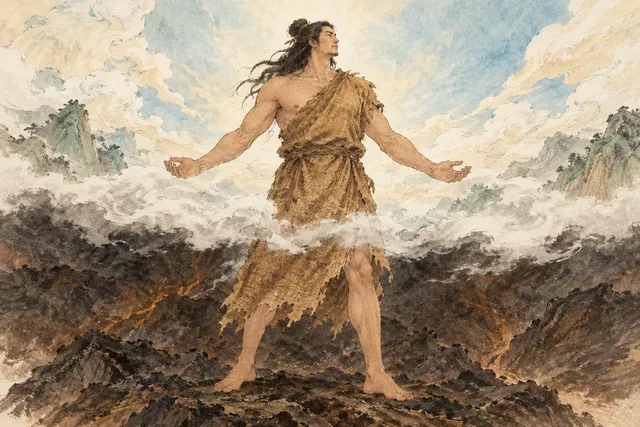
Xia
2070 BC — 1600 BC
According to legend, after Yu the Great tamed the floods, the throne passed to his son Qi, and power began to stay within one family. The Xia is remembered as China's first dynasty.
Most Xia stories were written down long after the events: Yu passing his own gate three times without stopping, the revival under Shaokang, the fall of the last king Jie. They read like a family tree passed on by word of mouth — details may waver, but the thread survived.
At Erlitou in Henan, archaeologists have uncovered wide palace foundations and bronzes from roughly the legendary Xia dates. Is it a Xia capital? Scholars still debate. Half of the Xia lies in books; the other half is still underground.
0 storiesStories from this age are still being prepared. Try another dynasty.
Shang
1600 BC — 1046 BC
The Shang is the first Chinese dynasty that left writing of its own. When a Shang king faced a big question, he asked the gods: the question was carved on a turtle shell or an ox bone, fire cracked the shell, and the answer was read from the cracks.
Those carved characters are **oracle bone script**, the ancestor of today's Chinese characters. With writing, Shang history stops being legend: Pan Geng moving the capital to Yin, King Wu Ding fighting beside the general Fu Hao, the fall of King Zhou — all leave traces.
The great Houmuwu cauldron from the Yinxu ruins weighs more than 800 kilograms; its bronze craft amazes even today's smiths. Here the Shang of the books meets the Shang of the ground.
0 storiesStories from this age are still being prepared. Try another dynasty.
Western Zhou
1046 BC — 771 BC
King Wu of Zhou overthrew the Shang king and founded a new dynasty with its capital at Haojing — the Western Zhou. The king granted land to relatives and comrades-in-arms, building a pyramid of lords: "All under heaven is the king's land."
The Duke of Zhou drew up rites and music — rules for sacrifices, banquets, and dress — and noble sons went to school. China's tradition of courtesy and propriety traces back to this time.
In the later years, King Li silenced the people's complaints, and King You lit the warning beacons just to win a smile. Crisis crept closer. In 771 BCE the Quanrong stormed Haojing; the Western Zhou ended, the kings moved east, and the Spring and Autumn age began.
0 storiesStories from this age are still being prepared. Try another dynasty.
Eastern Zhou · Spring and Autumn
770 BC — 476 BC
After the royal house moved east to Luoyi, the Zhou kings kept weakening while the great states kept growing. Big powers competed for the lead under the banner of "honour the king, repel the outsiders" — this is the Spring and Autumn period.
Duke Huan of Qi trusted the reformer Guan Zhong; Duke Wen of Jin came home after nineteen years of exile to lead the states; Goujian of Yue "slept on brushwood and tasted the gall". Many of the best-loved idiom stories were born here.
In this same age, Confucius traveled from state to state with his students, and Laozi left behind five thousand characters. Beyond the noise of the hegemons, Chinese thought was quietly sprouting.
0 storiesStories from this age are still being prepared. Try another dynasty.
Eastern Zhou · Warring States
475 BC — 221 BC
The hundred-plus states of the earlier age fought each other down to seven great powers: Qi, Chu, Yan, Han, Zhao, Wei, and Qin — the Warring States. War changed from contests for the lead into wars of annexation, and grew ever larger.
Every state raced to reform itself strong: Li Kui in Wei, Shang Yang in Qin. Su Qin and Zhang Yi wove alliances and betrayals; Lian Po and Lin Xiangru made peace between general and minister; Tian Dan broke the Yan army with his fire-ox charge. Stratagem and courage took the stage in turn.
The "hundred schools of thought" also peaked here: Mencius argued for kind government, Zhuangzi roamed free in thought, Xunzi taught, Han Fei completed the Legalists. In the end, it was Qin in the west that united the land.
0 storiesStories from this age are still being prepared. Try another dynasty.
Qin
221 BC — 207 BC
In 221 BCE, King Zheng of Qin conquered the last rival states and called himself the First Emperor, founding China's first centralized empire.
One script for writing, one gauge for axles, one set of weights and coins; highways radiating from the capital, walls joined into the Great Wall, and commanderies replacing feudal lords — the First Emperor carved the word "unified" into the next two thousand years of China.
But harsh laws and endless labour soon lit a rebellion. Chen Sheng and Wu Guang rose at Dazexiang; Xiang Yu and Liu Bang followed. The mighty Qin lasted only fifteen years.
0 storiesStories from this age are still being prepared. Try another dynasty.
Chu–Han Contention
207 BC — 202 BC
Once Qin had fallen, who would rule the land next? Xiang Yu and Liu Bang gave two answers: one a noble turned "Hegemon-King", the other a village chief turned "King of Han".
The blades at the Hongmen banquet, repairing the plank road in the open while marching through Chencang in secret, Han Xin's ambush on ten sides, the songs of Chu rising on four sides — in just four years, every duel became a treasury of idioms and stories.
In 202 BCE Xiang Yu died by his own hand at the Wu River, and Liu Bang founded the Han. This rise and fall has been retold for more than two thousand years.
0 storiesStories from this age are still being prepared. Try another dynasty.
Western Han
202 BC — 8 AD
The Han dynasty founded by Liu Bang made its capital at Chang'an. After the quiet recovery of the Wen and Jing reigns, under Emperor Wu the Han stood among the strongest states on earth.
Zhang Qian rode west and opened the Silk Road; Wei Qing and Huo Qubing pushed back the Xiongnu; Sima Qian endured shame to finish the Records of the Grand Historian. It was also under Emperor Wu that Confucian learning became the court's teaching.
Late in the dynasty, the regent Wang Mang seized the throne, and in 8 CE the Western Han ended. But the word "Han" had become one of the deepest names of this people.
0 storiesStories from this age are still being prepared. Try another dynasty.
Eastern Han
25 AD — 220 AD
Liu Xiu, a descendant of the Han royal house, rebuilt the dynasty amid the chaos and moved the capital to Luoyang — the Eastern Han. His reign brought peace again, and Cai Lun improved the making of paper.
Ban Chao gave up his brush to serve in the Western Regions; Zhang Heng built the first seismoscope; Hua Tuo healed the sick; Zhang Zhongjing wrote on fevers. Science, medicine, and history all shone in this dynasty.
In its last decades, empresses' clans and palace eunuchs fought over the court, and the Yellow Turbans shook the empire. After Dong Zhuo marched into the capital, warlords rose everywhere, and history slid into the Three Kingdoms.
0 storiesStories from this age are still being prepared. Try another dynasty.
Three Kingdoms
220 AD — 280 AD
As the Eastern Han fell apart, three kingdoms stood in balance: Wei under Cao Cao, who held the emperor to command the nobles; Shu under Liu Bei, who bowed three times at the thatched cottage to invite Zhuge Liang; Wu under Sun Quan in the southeast. Three great battles — Guandu, Red Cliffs, Yiling — drew the map of the tripod.
This was an age of heroes and stratagem: Guan Yu's thousand-li ride, Zhao Yun saving the young lord at Changban, Zhuge Liang serving "with all his heart until his death". And an age of letters: the three Caos and the Jian'an style are recited to this day.
The Three Kingdoms live so vividly in memory thanks to the novel Romance of the Three Kingdoms — seven parts fact, three parts fiction. It is worth reading beside the formal history, Records of the Three Kingdoms.
0 storiesStories from this age are still being prepared. Try another dynasty.
Western Jin
265 AD — 316 AD
Sima Yan took the throne from Wei and founded the Jin; in 280 he conquered Wu, and the three kingdoms became one. In the Taikang years the land knew a spell of peace.
It did not last. The emperor's grants of land to royal princes burst into the War of the Eight Princes, and the peoples along the frontier pushed in. Luoyang fell in 311 and Chang'an in 316 — the Western Jin was gone.
The tales of the Seven Sages of the Bamboo Grove belong to the Wei-Jin years. Their freedom and their sorrow are the other face of the age.
0 storiesStories from this age are still being prepared. Try another dynasty.
Eastern Jin
317 AD — 420 AD
When the Western Jin fell, Sima Rui rebuilt the dynasty in the south with its capital at Jiankang — the Eastern Jin. As northern families "crossed south in robes and caps", the Jiangnan region grew ever richer.
Great clans shared power with the throne, Zu Ti rose at cockcrow to drill, the few routed the many at the Battle of Fei River, Wang Xizhi wrote the Orchid Pavilion, and Tao Yuanming went home to farm. A dynasty huddled in the south, yet its arts thrived.
In 420 the general Liu Yu replaced Jin with his own Song, and history entered the Northern and Southern Dynasties.
0 storiesStories from this age are still being prepared. Try another dynasty.
Sixteen Kingdoms
304 AD — 439 AD
As the Western Jin collapsed, the Xiongnu, Jie, Xianbei, Di, and Qiang peoples founded regime after regime across the north and in Sichuan — more than twenty in all; sixteen of them were later counted together as the Sixteen Kingdoms.
These were restless years: regimes changed like lantern slides, and common people fled their homes in great numbers. They were also years of blending: peoples lived and intermarried side by side, folding stools and foreign foods entered the Central Plains, and Chinese ways reached the peoples of the steppe.
In 439 the Northern Wei united the north, the Sixteen Kingdoms closed, and the Northern and Southern Dynasties began.
0 storiesStories from this age are still being prepared. Try another dynasty.
N & S Dynasties
420 AD — 589 AD
From 420 to 589, the south and the north of China each ran through a string of dynasties: Song, Qi, Liang, and Chen in the south; in the north, the Northern Wei split into Eastern and Western Wei, then became Northern Qi and Northern Zhou — the Northern and Southern Dynasties.
Emperor Xiaowen of Northern Wei moved his court to Luoyang, took Chinese surnames, and ordered Chinese speech, drawing the peoples together; the great Buddhas of Yungang and Longmen were carved now. In the south, Zu Chongzhi calculated pi, and Jia Sixie wrote the Qimin Yaoshu on farming.
Amid the turmoil Buddhism flourished — "four hundred and eighty temples of the southern courts". In 589 a Sui army crossed the river, destroyed Chen, and China was one again.
0 storiesStories from this age are still being prepared. Try another dynasty.
Sui
581 AD — 618 AD
Yang Jian, a relative by marriage of the Northern Zhou house, took the throne and founded Sui; eight years later Sui crossed the river and destroyed Chen, ending nearly three centuries of division. Like the Qin, the Sui was short-lived — and like the Qin, it changed everything after it.
Emperor Yang dug the Grand Canal linking north and south, and the court began the examination system: scholars could win office by test rather than birth. Both lasted for over a thousand years.
But years of works and distant wars drained the people, and rebellions spread. Sui fell in 618; the Tang, close behind, carried its institutions to their height.
0 storiesStories from this age are still being prepared. Try another dynasty.
Tang
618 AD — 907 AD
The Tang was one of the most open and brilliant dynasties of old China. From Taizong's reign of good order, through China's only woman emperor Wu Zetian, to the splendour of Kaiyuan, Chang'an was the greatest city on earth.
Xuanzang walked to India for scriptures; Princess Wencheng married into Tibet; Jianzhen sailed for Japan. The poems of Li Bai, Du Fu, and Bai Juyi are recited to this day; Tang tricolour pottery and the Dunhuang murals keep the colours of that age.
The An Lushan rebellion turned splendour to decline; regional armies and palace eunuchs then ate away at the court. In 907 Zhu Wen usurped the throne, and the golden age of poetry closed.
0 storiesStories from this age are still being prepared. Try another dynasty.
Five Dynasties and Ten Kingdoms
907 AD — 960 AD
In the half-century after the Tang fell, the Central Plains ran through five dynasties — Later Liang, Tang, Jin, Han, and Zhou — while a dozen small states stood alongside: the Five Dynasties and Ten Kingdoms.
Regimes turned like lantern slides, yet there were bright spots: Emperor Shizong of Later Zhou reformed and readied reunification; ci, a new kind of lyric poetry, flowered in the southern states; woodblock printing spread far and wide.
In 960 the general Zhao Kuangyin was draped in a yellow robe by his soldiers at Chenqiao and founded the Song. The chaos slowly gathered back into one.
0 storiesStories from this age are still being prepared. Try another dynasty.
Song, Liao & Jin
960 AD — 1279 AD
The Song ruled as Northern Song and Southern Song, standing first beside Liao and Xia, then beside Jin, and falling at last to the Mongols. On the battlefield it often stood at a disadvantage; in economy and culture it was a peak of old China.
Bi Sheng invented movable type; the compass went to sea; gunpowder became weapons. Along the River at Qingming paints the bustle of Kaifeng; the ci of Su Shi, Li Qingzhao, and Xin Qiji, and the honour of Yue Fei and Wen Tianxiang, all belong to this age.
The oath at Chanyuan, the catastrophe of Jingkang, Yue Fei's northern campaigns, the last stand at Yashan — choices of peace and war ran through it all, leaving stories that still move readers.
0 storiesStories from this age are still being prepared. Try another dynasty.
Mongol & Yuan
1206 AD — 1368 AD
In 1206 Temüjin united the steppe tribes under the title "Genghis Khan" and founded the Mongol khanate. Mongol horsemen then swept across Eurasia; in 1271 Kublai declared the dynasty Yuan, and eight years later the Southern Song fell and China was one under Mongol rule.
The Yuan realm was vast beyond precedent: post roads ran to the horizon, travellers and goods moved freely, and Marco Polo's tales of Dadu amazed Europe. Qu — drama and verse — rose in the cities: Guan Hanqing's The Injustice to Dou E played out the sorrows and joys of ordinary life.
Graded rule by ethnicity and heavy taxes fed rebellion after rebellion. In 1368 Zhu Yuanzhang's army entered Dadu, the Yuan court rode north to the steppe, and the Ming began.
0 storiesStories from this age are still being prepared. Try another dynasty.
Ming
1368 AD — 1644 AD
Zhu Yuanzhang went from cowherd boy and novice monk to founding emperor. The Ming ruled first from Nanjing, then from Beijing. Zheng He sailed seven times to the Western Ocean, his great fleet reaching the east coast of Africa nearly a century before Columbus.
The dynasty repaired the Great Wall, raised the Forbidden City, and compiled the Yongle Encyclopedia. Yu Qian defended Beijing, Qi Jiguang fought the pirates, Zhang Juzheng pushed his reforms. Novels bloomed: Romance of the Three Kingdoms, Water Margin, and Journey to the West all took their lasting shape in Ming times.
Late in the dynasty, factional strife and natural disasters multiplied. In 1644 Li Zicheng took Beijing, the Chongzhen emperor died by his own hand, and the Ming fell.
0 storiesStories from this age are still being prepared. Try another dynasty.
Qing
1644 AD — 1839 AD
After the Manchu Qing entered through the pass, the empire reached its greatest extent under the Kangxi, Yongzheng, and Qianlong reigns: Taiwan recovered, the Dzungars defeated, Tibet governed — laying the outline of today's China.
Kangxi learned Western science from missionary tutors; Qianlong sponsored the Complete Library in Four Sections; Dream of the Red Chamber was written and Beijing opera took root. Population passed three hundred million, and market towns bustled.
But the closed-door policy let China slip behind the world. When the Opium War guns sounded in 1840, history turned into the heavy years of the late Qing.
0 storiesStories from this age are still being prepared. Try another dynasty.
Late Qing
1840 AD — 1911 AD
Defeat in the Opium War dragged China into "changes unseen in three thousand years". Power after power arrived; unequal treaties were signed one by one; the burning of the Old Summer Palace seared the country's memory.
The Chinese began to save themselves: Lin Zexu opened eyes to the world; the Self-Strengthening movement built ships and mills; the Hundred Days' reform tried to remake the state; Sun Yat-sen's Tongmenghui called for the end of imperial rule.
In 1911 a single shot at Wuchang was answered by province after province. Two thousand years of empire had reached their end.
0 storiesStories from this age are still being prepared. Try another dynasty.
Republic to 1949
1912 AD — 1949 AD
In 1912 the Republic of China was founded and the last emperor stepped down: the age of emperors was over. Warlords fought, the Northern Expedition marched, then came the War of Resistance against Japan and the civil war, as China searched, wave upon wave, for a new road.
It was also an age of awakening: the New Culture movement called for democracy and science, the May Fourth movement stirred the young, and schools, newspapers, and factories changed how people lived.
In 1949 the People's Republic was founded and the story of the Republican years closed. For this nearest stretch of history, textbooks, photographs, and grandparents' telling help us see it clearly.
0 storiesStories from this age are still being prepared. Try another dynasty.
— The timeline ends here; the stories continue —