 Dynasty Tales
Read by dynasty
Tap a dynasty to meet the children, heroes and big events of that age.
All the dynasties
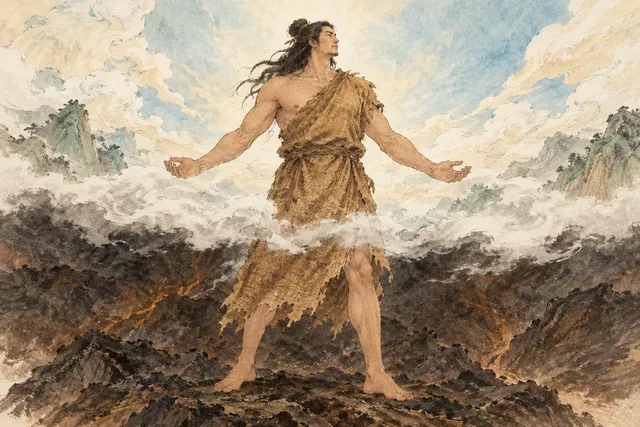
Ages without stories yet appear here tooPrehistoryAge of legends · 1 storiesBefore writing was invented, people kept the past alive by telling it, from grandparents to children. Pangu opening the sky, Nüwa making people, Shennong tasting a hundred herbs, the Yellow Emperor battling Chiyou — the heroes of these very old tales lived on in the telling.Xia2070 BC – 1600 BC · 0 storiesAccording to legend, after Yu the Great tamed the floods, the throne passed to his son Qi, and power began to stay within one family. The Xia is remembered as China's first dynasty.Shang1600 BC – 1046 BC · 0 storiesThe Shang is the first Chinese dynasty that left writing of its own. When a Shang king faced a big question, he asked the gods: the question was carved on a turtle shell or an ox bone, fire cracked the shell, and the answer was read from the cracks.Western Zhou1046 BC – 771 BC · 0 storiesKing Wu of Zhou overthrew the Shang king and founded a new dynasty with its capital at Haojing — the Western Zhou. The king granted land to relatives and comrades-in-arms, building a pyramid of lords: "All under heaven is the king's land."Eastern Zhou · Spring and Autumn770 BC – 476 BC · 0 storiesAfter the royal house moved east to Luoyi, the Zhou kings kept weakening while the great states kept growing. Big powers competed for the lead under the banner of "honour the king, repel the outsiders" — this is the Spring and Autumn period.Eastern Zhou · Warring States475 BC – 221 BC · 0 storiesThe hundred-plus states of the earlier age fought each other down to seven great powers: Qi, Chu, Yan, Han, Zhao, Wei, and Qin — the Warring States. War changed from contests for the lead into wars of annexation, and grew ever larger.Qin221 BC – 207 BC · 0 storiesIn 221 BCE, King Zheng of Qin conquered the last rival states and called himself the First Emperor, founding China's first centralized empire.Chu–Han Contention207 BC – 202 BC · 0 storiesOnce Qin had fallen, who would rule the land next? Xiang Yu and Liu Bang gave two answers: one a noble turned "Hegemon-King", the other a village chief turned "King of Han".Western Han202 BC – 8 AD · 0 storiesThe Han dynasty founded by Liu Bang made its capital at Chang'an. After the quiet recovery of the Wen and Jing reigns, under Emperor Wu the Han stood among the strongest states on earth.Eastern Han25 AD – 220 AD · 0 storiesLiu Xiu, a descendant of the Han royal house, rebuilt the dynasty amid the chaos and moved the capital to Luoyang — the Eastern Han. His reign brought peace again, and Cai Lun improved the making of paper.Three Kingdoms220 AD – 280 AD · 0 storiesAs the Eastern Han fell apart, three kingdoms stood in balance: Wei under Cao Cao, who held the emperor to command the nobles; Shu under Liu Bei, who bowed three times at the thatched cottage to invite Zhuge Liang; Wu under Sun Quan in the southeast. Three great battles — Guandu, Red Cliffs, Yiling — drew the map of the tripod.Western Jin265 AD – 316 AD · 0 storiesSima Yan took the throne from Wei and founded the Jin; in 280 he conquered Wu, and the three kingdoms became one. In the Taikang years the land knew a spell of peace.Eastern Jin317 AD – 420 AD · 0 storiesWhen the Western Jin fell, Sima Rui rebuilt the dynasty in the south with its capital at Jiankang — the Eastern Jin. As northern families "crossed south in robes and caps", the Jiangnan region grew ever richer.Sixteen Kingdoms304 AD – 439 AD · 0 storiesAs the Western Jin collapsed, the Xiongnu, Jie, Xianbei, Di, and Qiang peoples founded regime after regime across the north and in Sichuan — more than twenty in all; sixteen of them were later counted together as the Sixteen Kingdoms.N & S Dynasties420 AD – 589 AD · 0 storiesFrom 420 to 589, the south and the north of China each ran through a string of dynasties: Song, Qi, Liang, and Chen in the south; in the north, the Northern Wei split into Eastern and Western Wei, then became Northern Qi and Northern Zhou — the Northern and Southern Dynasties.Sui581 AD – 618 AD · 0 storiesYang Jian, a relative by marriage of the Northern Zhou house, took the throne and founded Sui; eight years later Sui crossed the river and destroyed Chen, ending nearly three centuries of division. Like the Qin, the Sui was short-lived — and like the Qin, it changed everything after it.Tang618 AD – 907 AD · 0 storiesThe Tang was one of the most open and brilliant dynasties of old China. From Taizong's reign of good order, through China's only woman emperor Wu Zetian, to the splendour of Kaiyuan, Chang'an was the greatest city on earth.Five Dynasties and Ten Kingdoms907 AD – 960 AD · 0 storiesIn the half-century after the Tang fell, the Central Plains ran through five dynasties — Later Liang, Tang, Jin, Han, and Zhou — while a dozen small states stood alongside: the Five Dynasties and Ten Kingdoms.Song, Liao & Jin960 AD – 1279 AD · 0 storiesThe Song ruled as Northern Song and Southern Song, standing first beside Liao and Xia, then beside Jin, and falling at last to the Mongols. On the battlefield it often stood at a disadvantage; in economy and culture it was a peak of old China.Mongol & Yuan1206 AD – 1368 AD · 0 storiesIn 1206 Temüjin united the steppe tribes under the title "Genghis Khan" and founded the Mongol khanate. Mongol horsemen then swept across Eurasia; in 1271 Kublai declared the dynasty Yuan, and eight years later the Southern Song fell and China was one under Mongol rule.Ming1368 AD – 1644 AD · 0 storiesZhu Yuanzhang went from cowherd boy and novice monk to founding emperor. The Ming ruled first from Nanjing, then from Beijing. Zheng He sailed seven times to the Western Ocean, his great fleet reaching the east coast of Africa nearly a century before Columbus.Qing1644 AD – 1839 AD · 0 storiesAfter the Manchu Qing entered through the pass, the empire reached its greatest extent under the Kangxi, Yongzheng, and Qianlong reigns: Taiwan recovered, the Dzungars defeated, Tibet governed — laying the outline of today's China.Late Qing1840 AD – 1911 AD · 0 storiesDefeat in the Opium War dragged China into "changes unseen in three thousand years". Power after power arrived; unequal treaties were signed one by one; the burning of the Old Summer Palace seared the country's memory.Republic to 19491912 AD – 1949 AD · 0 storiesIn 1912 the Republic of China was founded and the last emperor stepped down: the age of emperors was over. Warlords fought, the Northern Expedition marched, then came the War of Resistance against Japan and the civil war, as China searched, wave upon wave, for a new road.