Dynasty Tales
Floodwaters Cover the Central Plains
Long ago, tribes lived along the plains of the middle and lower Yellow River. The river watered their fields and helped keep people alive, so they could not live without it. But when the river rose in fury, no one could stop it.
At that time, the leader honored by all was Emperor Yao. Legend says that while Yao ruled, floods swept across the Central Plains. Water covered the fields and rushed into homes. Ordinary people helped their elders and carried their children as they fled to higher ground. Crops rotted in the fields, homes were gone, and each day became harder than the last.
This was not flooding in just one or two places. When the river rose, upstream and downstream became one wide sheet of water. No tribe could escape it. The strength of a single family or clan could never hold it back.
Yao could not sit by any longer. He called the leaders of the tribes together and spoke plainly: “If the water does not go down, people cannot survive. Who can control the flood?”
For a while, no one answered. The tribal leaders looked at one another. They all understood: the flood was urgent and could not wait even one day, but controlling it was no small task. Success would bring great credit; failure would mean grave blame.
After a long silence, someone finally spoke. “Gun can do it.” The others thought it over and nodded. Listening to them, Yao chose Gun.
Gun Builds Dikes
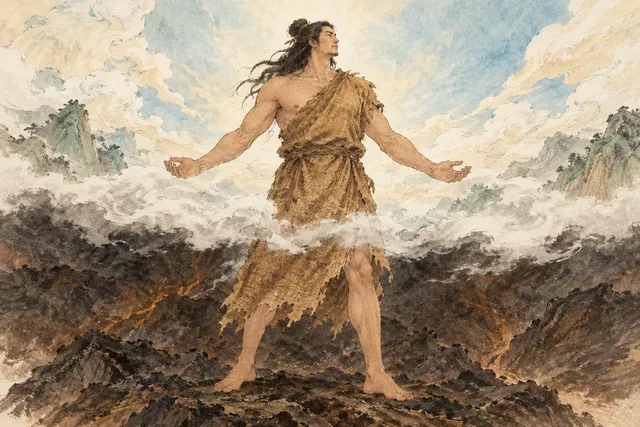
The story says that Gun was the father of Yu, later known as Yu the Great. Once he received Yao’s command, he began at once. His method was simple and direct: wherever the water came from, block it there.
The idea was not unusual. Holding back water to protect fields was an old way of dealing with floods, and it often worked in smaller floods. Gun was no fool. He packed the earth firmly, strengthened the foundations, and shaped the dikes to follow the river’s course. He did everything he could think of.
He led workers as they built dikes stretch by stretch along the banks. When the water rose higher, they raised the dikes higher too. The earthen walls ran farther and farther, and people felt somewhat safer as they watched them grow.
But the water would not obey. The higher the dikes grew, the higher the water rose. Trapped inside the dikes, the river grew deeper and deeper. When flood season came, it broke through the weakest places and flooded more fiercely than before.
Workers had barely sealed one breach before another collapsed. Gun stayed by the river day and night. He grew thin, and his eyes were streaked with blood. He could not understand it: they had not spared their strength or their labor, so why would the water not go down?
One group of laborers after another collapsed from exhaustion. Those carrying earth and pounding the dikes never knew whether the section they repaired today would still stand tomorrow. Some whispered, “Perhaps people cannot stand against this water.” Gun heard them. He said nothing and only brought his earth-pounder down harder.
Someone urged him to rest. Gun shook his head. “The people are still trapped in the water. How can I rest?”
Nine Years Without Success
One year, two years, three years passed. Spring came and autumn went, but Gun never changed his method.
Legend says that after nine years, the flood still had not calmed.
Nine years. Children who had fled the flood to high slopes had grown much taller, but their homes were still under water. More and more people in the tribes began to ask, “It has been nine years. Why is nothing getting better?” Gun heard those words.
His son Yu had watched his father struggle all along. Yu saw Gun guard the dikes by day and worry by night. Yu asked few questions, but quietly remembered everything.
Late one night, Gun sat alone on a dike and stared at the dark river. Again and again, he wondered: what was wrong with the dikes?
They could not grow high enough. No matter how quickly earth dikes were piled up, the water rose faster. What if there were a kind of earth that grew by itself? As the water rose, it could rise too, until even the largest flood could not wash over it.
He thought of xirang.
In the myth, the Heavenly Emperor possessed a magical earth called xirang. Once it touched the ground, it grew, rising higher and higher without stopping. Gun thought that with it, the flood would finally meet its match.
But xirang belonged to the Heavenly Emperor. Would he lend it to the human world? Gun stared at the rolling water for a long time without speaking.
As the eastern sky began to brighten, he finally made his decision. It changed his own fate and placed his son Yu before the flood.
Taking Xirang at Night
Legend says that Gun told no one. Under cover of night, he set out alone.
The Heavenly Emperor held the xirang. By the rules, anyone who wished to use it had to report first and wait for the emperor’s permission. But the flood would not wait. For every day the water remained, more people could not return home. Gun knew that this journey broke the rules.
Halfway there, he stopped. Looking back, he saw faint lights shining from makeshift huts on the high slopes of the riverbank. Families still trapped beside the flood lived there. He gritted his teeth and went on.
He quietly reached the place where the xirang was kept, seized a handful of the magical earth, tucked it inside his clothes, and turned away. Against his chest, it felt faintly warm.
Along the way, he kept telling himself: First stop the flood. Then I will ask the Heavenly Emperor’s forgiveness. The troubles of the human world cannot wait; I alone will bear the punishment from Heaven.
Before dawn, he was back beside the river.
The Earth Grows, and the Water Recedes
The most dangerous place was an old breach in the dike. Again and again it had been sealed, then broken open, swallowing the labor of countless people.
Gun stood before the gap, grabbed the xirang, and scattered it into the water.
Nothing happened.
The laborers looked at one another. Someone muttered, “What good can such a little bit of earth do?”
Before the words had faded, the earth at the water’s edge began to move. A handful became a mound, and the mound became a stretch of ground. It pushed upward and spread to both sides. As the water rose, the earth grew faster. The muddy river crashed against it and was forced back.
“It is growing! It is growing by itself!” someone cried from the crowd.
Gun’s hands trembled. For the first time in nine years, he saw a dike growing faster than the water.
During those days, Gun hardly closed his eyes. Wherever the water surged hardest, he scattered xirang. The laborers followed behind, tamping it down and building it up, working harder than ever. One breach after another closed. Beyond the dikes, the water slowly dropped, uncovering mud that had not been seen for a long time.
News spread, and people came from every direction to see. Elders leaned on walking sticks. Children rode on adults’ shoulders. From the high slopes, they watched the water retreat, and some wept on the spot. When Yao heard that the water was falling, he too breathed a long sigh of relief.
Yu was among the crowd as well. He looked at his father’s face, caked with mud and water. He had not seen that kind of smile on Gun’s face for a long time.
But Yu did not cheer with the others. He crouched down and watched the retreating water. A question rose in his mind: if the water was blocked, where would it go?
That night, Yu went to his father and asked softly, “Father, where did that earth come from?”
Gun looked at the dark river for a long time before he answered. “You need not ask. It is a good thing that the water has gone down.”
Yu did not ask again. But he saw that his father’s eyes were not at ease when Gun looked toward the sky.
Trouble in Heaven
The myth says that trouble had begun in Heaven.
The Heavenly Emperor went to inspect the place where xirang was stored and found that a lump was missing. His face darkened. When he asked about it, he learned that Gun of the human world had taken it.
“What nerve!” the Heavenly Emperor thundered. “Xirang is a treasure of Heaven and Earth. He did not report to me or wait for my command, yet he dared to take it for himself and block the flood!”
The gods in the hall fell silent. No one dared speak for Gun.
The Heavenly Emperor was silent for a moment. His gaze passed through the clouds to the newly built dike in the human world. The dike was still growing, and the water was still receding.
But to him, that ever-higher dike was not an achievement. It was proof of guilt. A broken rule was still a broken rule.
Meanwhile, Gun still stood on the dike, watching the water slowly fall. He had no idea that a storm fiercer than the flood was closing in on him.
Xirang Is Taken Back
In the legend, the Heavenly Emperor’s anger came faster than floodwater.
One morning, Gun went up the dike for his usual inspection. Suddenly, the earth beneath his feet stopped moving. The xirang that had pushed upward only the day before had become lifeless earth overnight. The laborers stood frozen, unable to explain what had happened.
Then the water turned. The muddy waves that had retreated came roaring back and struck the unfinished dike. One section collapsed, then two, and soon the breaks ran together. Huts that had only just stood on uncovered mud sank beneath the water again.
Gun stood still before the broken dike. He understood that what he had feared had come.
Not long afterward, the Heavenly Emperor punished Gun, and Gun died at Feather Mountain. He did not live to see the water go down. All he left behind was an unfinished dike and a silent son.
Nine years of labor ended half in the water and half under the laws of Heaven.
Yu Takes Up the Task
The dikes had fallen, and the water was still rising. By then, Shun was the leader of the realm. After thinking carefully, he turned his attention to Yu.
Some people objected. “Gun was a condemned man. Can his son really be trusted?”
Shun said, “Gun built those dikes, and Gun left behind their lesson. Who has seen that lesson more clearly than his son?”
Yu accepted the burden. He did not refuse, but neither did he rush to begin. First he walked the length of the river. He studied the dikes his father had built, the places where they had broken, the way water struck, and the way earth collapsed. At a breach, he crouched down, took a handful of mud, and slowly crumbled it between his fingers.
The question that had come to him that night returned: if the water was blocked, where would it go?
Now he had an answer. Water could not simply be blocked. The higher the dikes, the more fiercely the water was trapped; once it broke through, it was more violent than before. His father had failed for nine years not because Gun had failed to work hard. The mistake lay in one word: block.
Yu called the laborers to the river and said something that surprised them. “This time, we will not build higher dikes. We will dig channels instead.”
A stir ran through the crowd. They could not block the water, and now Yu meant to let it through?
Yu pointed at the rushing river. “Water naturally flows downhill. Give it a path, and it will make its own way to the sea.”
Guiding the Water to the Sea
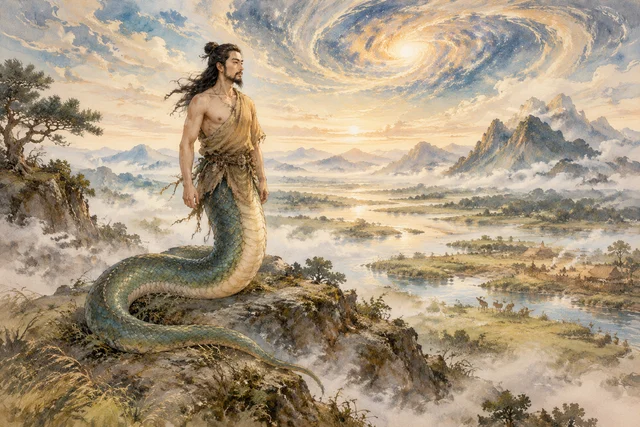
Yu acted as soon as he spoke. He led people to study the land and follow the shape of the mountains. Where the ground was high, they went around it; where it was low, they directed water through it. When mountains blocked the way, they cut openings through them. This was called “following the mountains and dredging the rivers.”
Yu carried tools himself and walked at the front. He ate and lived alongside the laborers. Over time, thick calluses formed on his hands, and old injuries marked the soles of his feet.
Once, when the group passed Yu’s home, the cry of a baby came from inside. His companions urged him, “Go in and take one look.”
Yu looked toward the door and waved his hand. “Until the water goes down, countless families cannot settle safely. My own family’s needs can wait.”
Then he walked on. Legend says this happened more than once: Yu passed his home three times without entering.
One newly dug channel followed another. Standing water flowed down through the ditches and into the sea. More and more muddy ground appeared. Families who had fled to the high slopes carried down their hoes, returned one household at a time, turned the soil, and sowed seeds again.
Yu’s method was entirely different from his father’s. He did not struggle against the water. He simply made a path for it. The flood that could not be blocked was slowly led away.
When the flooding was brought under control, Yu’s name spread in every direction, and people across the realm looked to him. But the matter was not over. One day, leadership would have to pass to someone else. Who would receive it, and how? That question was harder than the flood. Before long, an old rule people took for granted would quietly change in the hands of Yu’s son.