Dynasty Tales
In the late Spring and Autumn period, the Zhou king could no longer control the land. The feudal states fought one another. Jin and Qi stood in the Central Plains, while two powerful new rivals had risen in the south: Wu and Yue. Wu lay in the lower Yangtze River region, with its capital at Gusu, in present-day Suzhou, Jiangsu. Yue lay south of Wu, with its capital at Kuaiji, in present-day Shaoxing, Zhejiang. Their waterways and borders met, so boats served better than horses in war.
The ruler of Yue was King Goujian. He was still young when his father, Yunchang, died and he inherited the throne. Yue was remote and not very strong, but Goujian dared to act and listened to capable advisers. Wu's ruler was King Helu. With Wu Zixu and Sun Wu serving him, Helu had a strong army and dreamed of becoming the leading ruler among the states. The two neighbors were bound to clash.
The Battle of Zuili: A Bitter Enemy Is Made
In 496 BCE, Yunchang died. Goujian had only just become king, and Yue was holding mourning rites when Helu saw his chance and sent his army south.
Goujian met him at Zuili, southwest of present-day Jiaxing, Zhejiang. The Wu army held a firm formation. Yue soldiers charged several times but could not break through. Goujian grew desperate and chose a brutal plan. He sent a group of condemned prisoners before the Wu lines. They shouted together, drew their swords, and killed themselves. The Wu soldiers had never seen anything like it and stared in shock. At that moment, Yue troops attacked from both sides. The Wu army fell into confusion and retreated in defeat.
Helu injured his foot amid the fighting. His wound worsened during the retreat, and he died before his army had gone far.
Before he died, Helu called his son Fuchai to his bedside and asked only, “Can you forget Goujian?”
Fuchai clenched his teeth. “I dare not forget.”
After Fuchai took the throne, he ordered a man to stand in the courtyard. Whenever Fuchai entered or left, the man shouted, “Fuchai, have you forgotten that the king of Yue killed your father?” Fuchai answered, “I dare not forget.” Day after day, his father's death weighed on him. He relied heavily on Wu Zixu and drilled his navy day and night, waiting to take revenge.
Goujian Attacks First
In 494 BCE, Goujian heard that Wu was gathering and training its army. He lost patience and decided to strike first.
Fan Li, a senior adviser, tried to stop him. “Weapons bring harm, and fighting goes against what is right. The side that starts a war will suffer for it.”
Goujian waved a hand. “I have made my decision.”
But the Wu army was ready. Fuchai led his forces himself, and the two armies fought at Fuqiao, near present-day Lake Tai. Wu's navy attacked fiercely with the current. Yue was badly defeated; its boats sank and its soldiers scattered. Goujian fled home with the survivors.
Trapped on Mount Kuaiji
The defeated troops withdrew to Mount Kuaiji, southeast of present-day Shaoxing, Zhejiang. The Wu army pursued them and surrounded the mountain. Food could no longer reach them, and no reinforcements came. From the mountaintop, Goujian saw Wu campfires stretching below him. He understood that if the fighting continued, Yue would be destroyed.
He summoned Fan Li, who was skilled in war, and Wen Zhong, who was skilled at governing a state. Neither man spoke of fighting again.
Goujian asked, “What can we do now?”
Wen Zhong answered, “A hard fight leads only to death. The king of Wu hates you deeply, but his court is not united. There is only one path now: bow your head and ask for peace.”
Goujian said nothing for a long time. His clenched hands turned pale. A ruler would have to kneel before Fuchai, the king who had defeated him. How could he swallow that humiliation? Yet if he could not, the ancestral shrines and the people of his state would be lost.
Gifts for Prime Minister Bo Pi
That night, Wen Zhong went down the mountain. He carried Yue's remaining treasures and several beautiful women. Instead of going directly to Fuchai, he first slipped into the camp of Bo Pi, Wu's taizai, or chief minister.
Bo Pi directed Wu's government. He loved money and flattering words. Wen Zhong laid out the gifts one by one and said quietly, “The king of Yue is willing to become the king of Wu's subject. Everything in Yue may be used by Wu. We ask only that you speak well of us before the king.”
Bo Pi could not take his eyes off the treasures covering the table.
The next day, he told Fuchai, “The king of Yue has yielded. He will become your subject and send tribute. Your Majesty aims to lead the states. Why destroy a small state completely?”
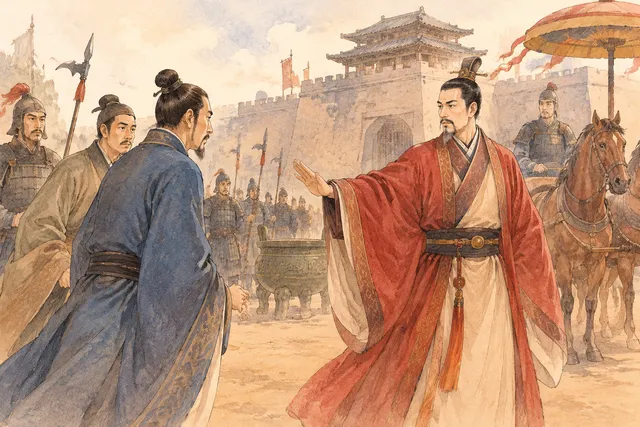
Fuchai was tempted. Then Wu Zixu strode in. “No! Wu and Yue cannot exist side by side. If you release Goujian today, he will become a great danger one day!”
Wu Zixu's words made sense. But Fuchai wanted to go north and compete with the lords of the Central Plains. He did not want to spend more time in the south. He looked from Wu Zixu to Bo Pi, then finally waved his hand. “Enough. Yue shall submit, and Goujian and his wife shall come to Wu as servants.”
The siege below Mount Kuaiji ended. Yue survived, but its king's honor had been trampled into the mud.
Three Humiliating Years in a Stone Hut
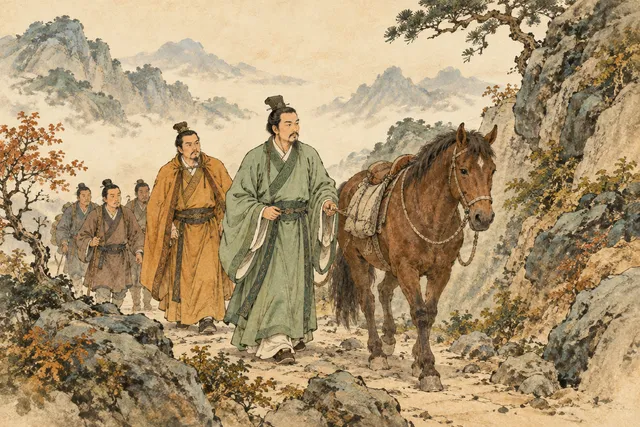
In the later tradition, Goujian and his wife boarded a boat north, with Fan Li traveling beside them. Wen Zhong was left in charge of Yue’s affairs.
On the day they left, the officials saw them off at the riverbank. Goujian turned back and said only, “I entrust Yue to all of you.” No one dared raise his head. Crying filled the riverbank.
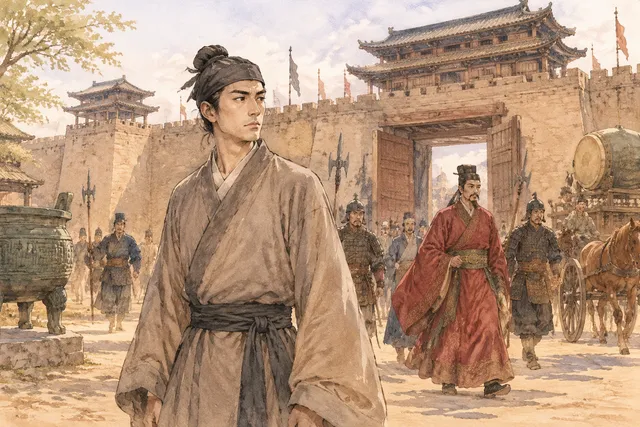
At Gusu, Fuchai placed them in a stone hut beside Helu's tomb. Goujian took off his royal robes and put on rough clothes. Every day he tended the king of Wu's horses and shoveled manure. His wife carried water and swept the floor. Fan Li chopped firewood and tended the fire. When Fuchai traveled, Goujian led the horse at the front.
People of Wu pointed in the streets. “Look, that is the king of Yue.”
Goujian kept his head down and said nothing.
At night, a dim lamp lit the stone hut. He asked Fan Li, “Will I never be able to return?”
Fan Li replied, “Your Majesty, endure for a while, and you may have a lifetime ahead. The king of Wu wants to see you bow. The lower you bow, the safer he will feel.”
Goujian nodded, gritting his teeth until they clicked.
Wu Zixu never relaxed his watch. Again and again he told Fuchai that Goujian would remain a danger unless he was killed. But whenever Fuchai saw Goujian bent over as he led a horse, he felt that Goujian's spirit had been broken and that there was nothing to fear.
Tasting Fuchai's Stool: A Narrow Chance
Later tradition tells another story: more than two years passed, and Fuchai suddenly became ill. He lay sick for days, and the medicines did not help.
When Goujian heard, he murmured to Fan Li, “The chance has come.”
He asked to see Fuchai and knelt by the bed. “Your servant wishes to examine Your Majesty's illness.” He took some of Fuchai's stool and tasted it before everyone. Then he bowed low. “Congratulations, Your Majesty. You will soon be well.”
Fuchai stared at him. “How do you know?”
Goujian answered, “Your servant knows a little medicine. Its bitter and sour taste shows that the illness is leaving.”
A few days later, Fuchai really did recover. He sighed. “You care for me more devotedly than a son would.”
The small amount of caution in Fuchai's heart loosened.
Wu Zixu grew anxious and warned him again and again. But Fuchai said, “Goujian serves me loyally. If I killed him, even Heaven would not permit it.” He ordered Goujian released to return home.
Three years had passed. On the day the boat left shore, Goujian looked back once at Gusu. He neither smiled nor cried.
Behind him lay three years of humiliation. Ahead lay a shattered Yue: little grain in the storehouses, too few people in the fields, and hardly any soldiers able to fight. How could such a state rise again?
Sleeping on Brushwood, Tasting Gall, and Rebuilding Yue
After returning to Yue and its capital, Kuaiji, in present-day Shaoxing, Goujian first removed the fine bedding.
The Records of the Grand Historian says that Goujian placed gall beside his seat. He looked up at it when sitting or lying down and tasted it at meals, reminding himself not to forget the defeat at Kuaiji. Sleeping on brushwood is a detail that circulated in later tradition.
This is the story behind the idiom “sleeping on brushwood and tasting gall.”
Hatred alone could not restore the state. Yue first had to recover. Wen Zhong and Fan Li helped Goujian increase the population, store grain, and train troops. Little by little, Yue rebuilt its strength.
Goujian ordered that parents would be punished if young men and women of marriageable age did not marry. The government gave rewards when children were born. Goujian worked in the fields himself, and his wife wove cloth with her own hands. They ate no extra meat and did not seek fine clothes. Goujian treated able people with respect and personally asked suffering people about their troubles.
Wen Zhong managed domestic affairs, while Fan Li managed military matters. Little by little, Yue's granaries filled and its soldiers were trained.
And Wu? Fuchai treated Goujian like a tamed dog. He focused on competing for power in the north, building high platforms and large ships.
A Loyal Minister Takes His Own Life
In 484 BCE, Wu's army defeated Qi's army at Ailing, south of present-day Tai'an, Shandong. Fuchai was delighted, and congratulations filled the court.
Only Wu Zixu would not join the celebration. He said in court, “Qi is only stony farmland. Even if you gain it, it will not grow grain! Yue is the danger at our heart!”
Fuchai had grown tired of listening. Bo Pi added, “Wu Zixu holds resentment against Your Majesty.”
In anger, Fuchai sent Wu Zixu a sword.
Wu Zixu accepted it and told his attendants, “After I die, plant catalpa trees over my grave, so they can make a coffin for the king of Wu. Take out my eyes and hang them on the city gate. I want to see the Yue army enter the city!”
Then he cut his own throat and died.
Wu's last great supporting pillar had fallen. When Yue received the news, Goujian asked Fan Li, “Can we act now?”
Fan Li shook his head. “We must wait. Wu's best soldiers are still there.”
Gusu Falls; Fuchai Takes His Own Life
In 482 BCE, Fuchai personally led his best soldiers north to Huangchi, southwest of present-day Fengqiu, Henan, to compete with Jin for leadership of the allied states. Only older people, the young, and the crown prince remained in the capital, Gusu.
Fan Li struck the table. “Now is the time!”
The Yue army attacked by water, entered Gusu, killed the crown prince, and burned the Gusu Terrace.
When the news reached Huangchi, Fuchai's face turned pale with anger. He blocked the news from spreading, hurriedly completed the alliance, and rushed home. By then Wu's army was exhausted, but Yue was not sure it could destroy Wu in one blow, so Goujian agreed to make peace.
But this pause was only a chance to catch breath. Afterward Yue sent out armies again and again, while Wu grew weaker each year. In 473 BCE, Yue surrounded Gusu, and at last the city fell.
Fuchai withdrew to Mount Gusu and sent an envoy to seek peace. He may have remembered when his own army had trapped Goujian at Kuaiji. Hearing the envoy’s plea, Goujian felt pity and wanted to agree.
Fan Li stopped him. “Have you forgotten the suffering at Kuaiji? In those days Heaven gave Yue to Wu, and Wu would not take it. Today Heaven gives Wu to Yue. Can we still refuse it?”
Fan Li ordered the army forward and sent the envoy away. Goujian still pitied Fuchai. He sent an offer to settle him at Yongdong, around present-day Zhoushan in Zhejiang, with a hundred households under his rule.
Fuchai refused. “I am old and can no longer serve Your Majesty,” he said. “I have no face to meet Zixu.” He covered his face with cloth, drew his sword, and killed himself.
Years before, Fuchai had surrounded Goujian. Now Fuchai was the one surrounded. The balance between their states had turned, and Wu came to an end.
After destroying Wu, Goujian led his army north across the Huai River. At Xuzhou, near present-day Tengzhou, Shandong, he met with the feudal lords and became the last hegemon of the Spring and Autumn period. All Yue celebrated.
Only Fan Li did not drink at the victory feast. He looked at Goujian seated high above the others and remembered the stool and gall that Goujian had tasted. A chill came over him: if this man could be so hard on himself, what might he do to ministers who had served him well?
That night, Fan Li quietly packed his belongings and wrote a letter to his old friend Wen Zhong.