Dynasty Tales
A Troubled Spring and Autumn Period
This traditional account is set in central China in the seventh century BCE, when the world had changed greatly. The Zhou king still sat at Luoyi, present-day Luoyang in Henan, but few obeyed him. Regional rulers held their own lands, and the strongest army could take the lead. The Rong and Di peoples to the north and Chu to the south repeatedly moved into the central states.
Then Qi, in the east, began to lead. Its lands lay in present-day Shandong, where the sea provided fish and salt. Its ruler, Duke Huan, had known hardship. During a struggle for the throne with his brother, he had lived in exile. His opponent Guan Zhong shot an arrow that struck his belt hook. He bit his tongue and pretended to be dead, escaped, and hurried home first to take the throne.
Guan Zhong might have remained his bitter enemy. But the adviser Bao Shuya told him, “If you want to become overlord, you need Guan Zhong.” Duke Huan set aside his old hatred and appointed Guan Zhong as his chief minister.
Guan Zhong did not disappoint him. He reorganized government, developed income from salt and iron, and trained the army. Qi grew stronger each year. He also gave the duke a guiding cause: honor the Zhou king and resist incursions from outside peoples. That gave Qi a stated reason to send troops, and other rulers were willing to follow.
Yan Calls for Help
In 663 BCE, the Shanrong advanced from the north and attacked Yan. Yan's capital was at Ji, in the area of present-day Beijing. Small and weak, Yan could not hold them back. It sent messengers racing day and night to ask Qi for help.
Kneeling in the hall, a messenger spoke urgently. The Shanrong's mounted forces moved like the wind. Unless Qi sent an army, Yan would fall.
The duke looked toward Guan Zhong. After a moment, Guan Zhong said, “Yan guards the northern gate. If that gate falls, Qi will be next. Helping Yan means helping ourselves.”
“Then we send the army,” the duke said.
Some officials were uneasy. The Shanrong lived far to the north, beyond high mountains and dangerous roads. What if the army went too far and something happened? Guan Zhong did not argue at length. “Honoring the king and resisting incursions cannot be just words,” he said. The duke struck the table, and the decision was made.
Guan Zhong would travel with the army. So would an official named Xi Peng, a careful man who liked to think problems through. When difficulties arose, Guan Zhong often listened to his advice.
Marching North
The army left in spring. Qi's war chariots rolled out one after another, heading north. They reached Yan and then went farther. People and villages became fewer.
In Yan, the Shanrong avoided a direct clash and withdrew north. Yan was safe, but Duke Huan would not end the campaign. Driven away once, the attackers might return. He wanted to push them back far enough that they would not dare.
The army crossed beyond Yan and pursued the Shanrong into their own territory. Qi won its battles, scattering opposing forces into the mountains. Then the duke heard of Guzhu, farther north, a state closely connected with the Shanrong. Unless that ally was dealt with, he believed the frontier danger would remain. The army continued toward Guzhu.
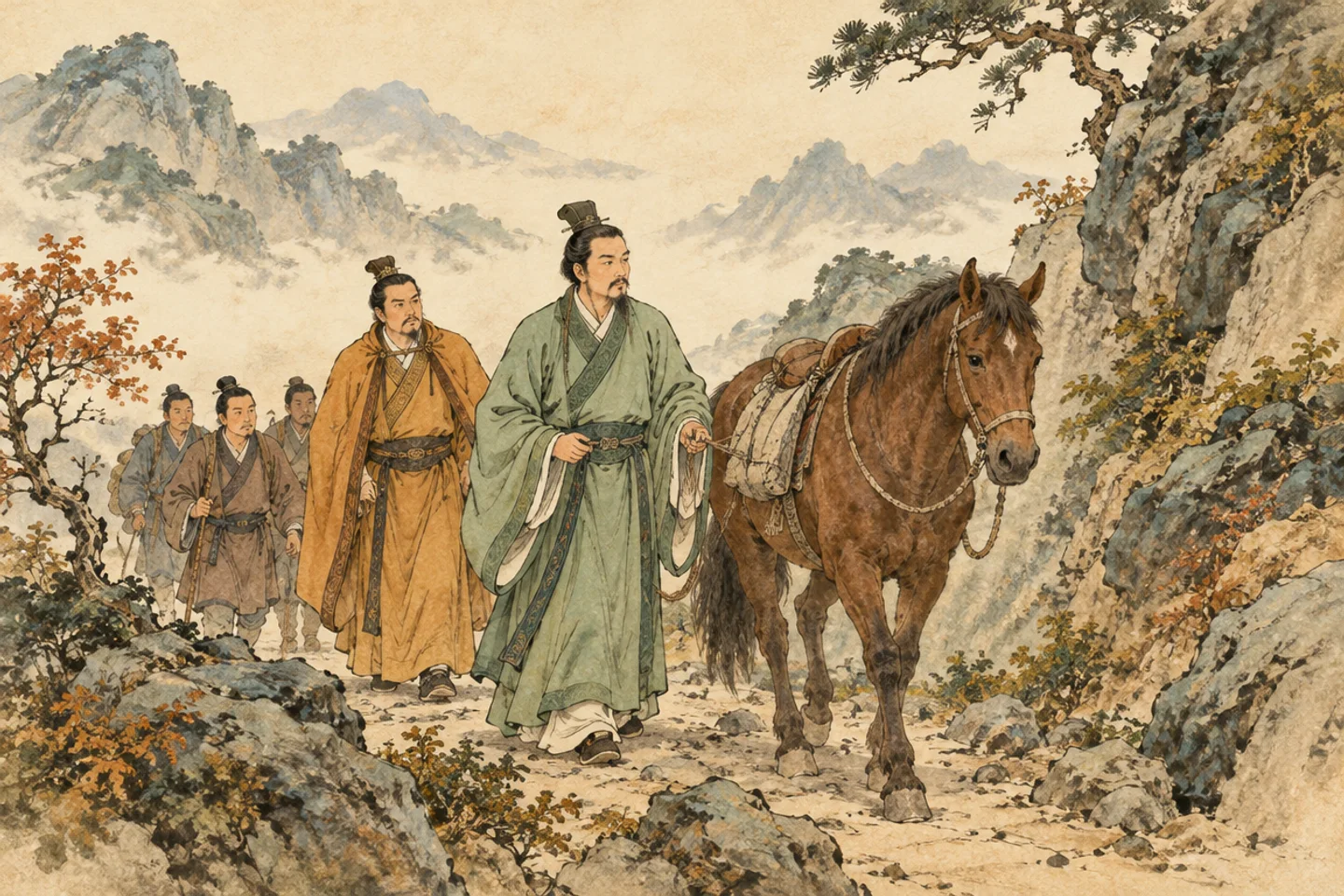
The farther north they went, the harder the roads became. Plains gave way to hills, and hills rose into mountains. Valleys followed valleys. Branching paths spread like a web. No one in the army, from generals to foot soldiers, really knew the region.
Riding his horse, Guan Zhong looked at the seemingly endless mountains ahead. His brow slowly tightened.
This victorious army was about to face a simple question it could not answer: where was the road?
Lost in the Mountains
The fighting was over, but the road home was lost.
By the end of the campaign around Guzhu, the season had changed. They had set out in spring. Now the grass was dry, leaves were falling, and the north wind grew stronger each day. The duke ordered the army home, and it turned south.
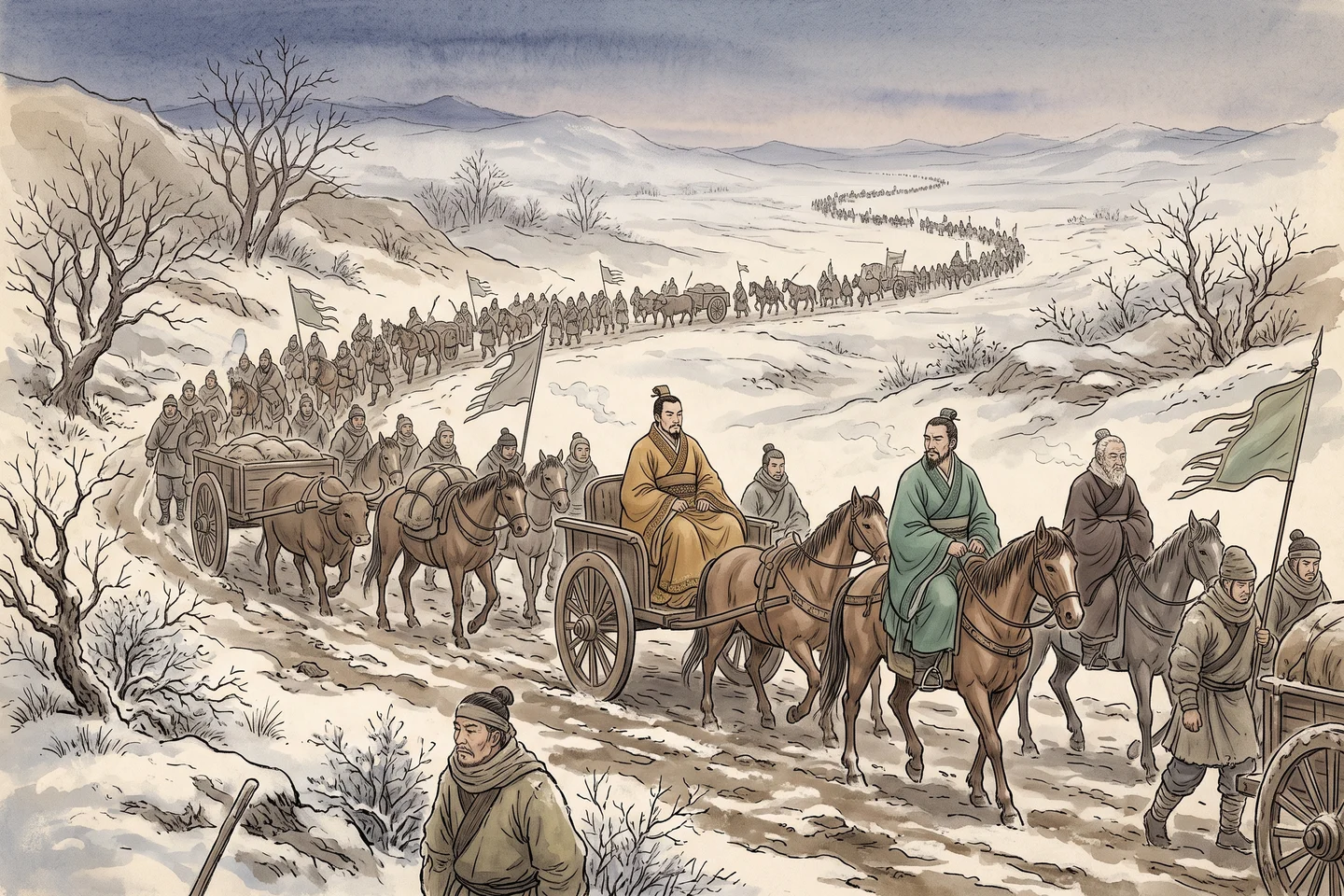
The first day went well enough. On the second, something strange happened. A ridge they had crossed the day before rose in front of them again. By the third day, the valleys ahead looked just like those behind. Even the cracks in the rock seemed familiar.
They had entered the mountains pursuing retreating Shanrong soldiers. No one had paid much attention to the route. There were no broad roads, only animal tracks that divided again and again.
Commanders sent men in different directions to search. The scouts returned at nightfall, shaking their heads. One way ended at a cliff; another led into a closed valley. Someone found flattened grass in the woods. Looking closely, he recognized the tracks of their own army. After hours of walking, they had come back to the same place.
Trouble on Every Side
More difficulties followed. The paths were narrow and steep. Chariot wheels wedged between rocks, and soldiers had to push them free. Food supplies shrank each day, and the water bags were nearly empty.
Someone suggested climbing high to look around. Soldiers reached the tallest peak, but saw only more mountains, without even a thread of cooking smoke. Others wanted to go back the way they had come. Fallen leaves had already covered that path. Who could tell where it was?
Fear was worse than the difficult ground. Soldiers who had just won a campaign now rushed about without direction. Beside the campfires at night, whispers began: was a mountain spirit keeping them here to die?
The duke summoned Guan Zhong to his tent. His face was grim.
“Zhongfu, if we keep going in circles, we will collapse before any enemy attacks.” Zhongfu was the duke's respectful name for Guan Zhong, treating him as an elder adviser.
Guan Zhong did not answer at once. He left the tent and looked at the dark mountains.
Scouts could not find the road. There was no one to ask—not even a woodcutter in these empty hills. If human eyes could no longer help, what else might know the way?
Letting the Horses Lead
Warhorses were tied outside the tent. In the cold, their breath showed white as they lowered their heads to chew grass. A few were old, with graying coats but steady steps.
As Guan Zhong watched, an idea came to him. These old horses had traveled with the army for years, north and south. They had covered more roads than many of the soldiers. Horses could remember routes and recognize the direction home. If the people were confused, perhaps the animals were not.
He returned to the tent. “We can make use of the old horses' knowledge,” he told the duke.
The duke stared. “Let horses lead us?”
“No one has another plan. We lose nothing by trying.”
The duke thought for a while, then nodded.
At dawn, Guan Zhong ordered several old horses brought to the front of the army and their reins loosened. He repeated his instructions: follow wherever the horses go. No one was to pull them one way or another.
Many men shook their heads privately. Could they really stake the whole army's life on a few animals?
But they had no other way.
An old horse stood for a moment, flicked its tail, lifted its head, and sniffed the wind. Then it began to walk.
The army followed slowly, scarcely daring to breathe. After a while, they reached a fork. The horse stopped.
Which path would it choose? Would this turn lead them out, or into another closed valley?
The Old Horse Knows the Way
At the fork, the horse lowered its nose toward the ground. It sniffed, looked toward the narrow path on the left, and stepped into it.
The army followed.
At first, the path was hard going. Stones lay everywhere, and thorns tore at the soldiers' coats. Some feared they were entering another dead end. After part of a day, however, the road widened and the slope eased. At the next fork, the horse turned right with hardly a pause.
One fork, then two, then three. The old horse was slow, but never turned back. The muttering faded. Once again, the wheels rolled over the gravel in a steady rhythm.
Toward evening, a soldier at the front shouted, “Wheel tracks!”
Everyone gathered around. Two deep grooves ran through the mud, left by their chariots on the way in. Leaves had covered them, and the wind had uncovered them again. The old horse stepped onto the tracks as though crossing its own doorstep.
The duke climbed down and crouched to touch the tracks. For a long time, he said nothing. Then he walked to the old horse and patted its gray-white neck.
“Zhongfu, I have led armies for years. Only today have I learned that eyes are not the only things that know a road.”
Guan Zhong smiled. “There are also the feet that have traveled it.”
Looking for Water
They had found the road, but another problem remained: water.
After so many days wandering, the water bags were empty. The soldiers' lips were cracked, and the warhorses panted. No streams appeared beside the path, and the valleys held not even a puddle.
This time, Xi Peng had an idea.
The Qi official crouched beside a slope and watched for a long time. Then he looked up. “My lord, ants live on the south side of a mountain in winter and the north side in summer. It is winter now. Where they have built a mound, there may be water below.”
Someone scoffed. “Can a few insects show us water?”
The duke answered, “At this point, we can try.”
Soldiers searched in different directions and found a tall ant mound on a sunny slope. They dug beneath it. First the soil darkened, then it grew damp. Farther down, clear water slowly seeped into the hole.
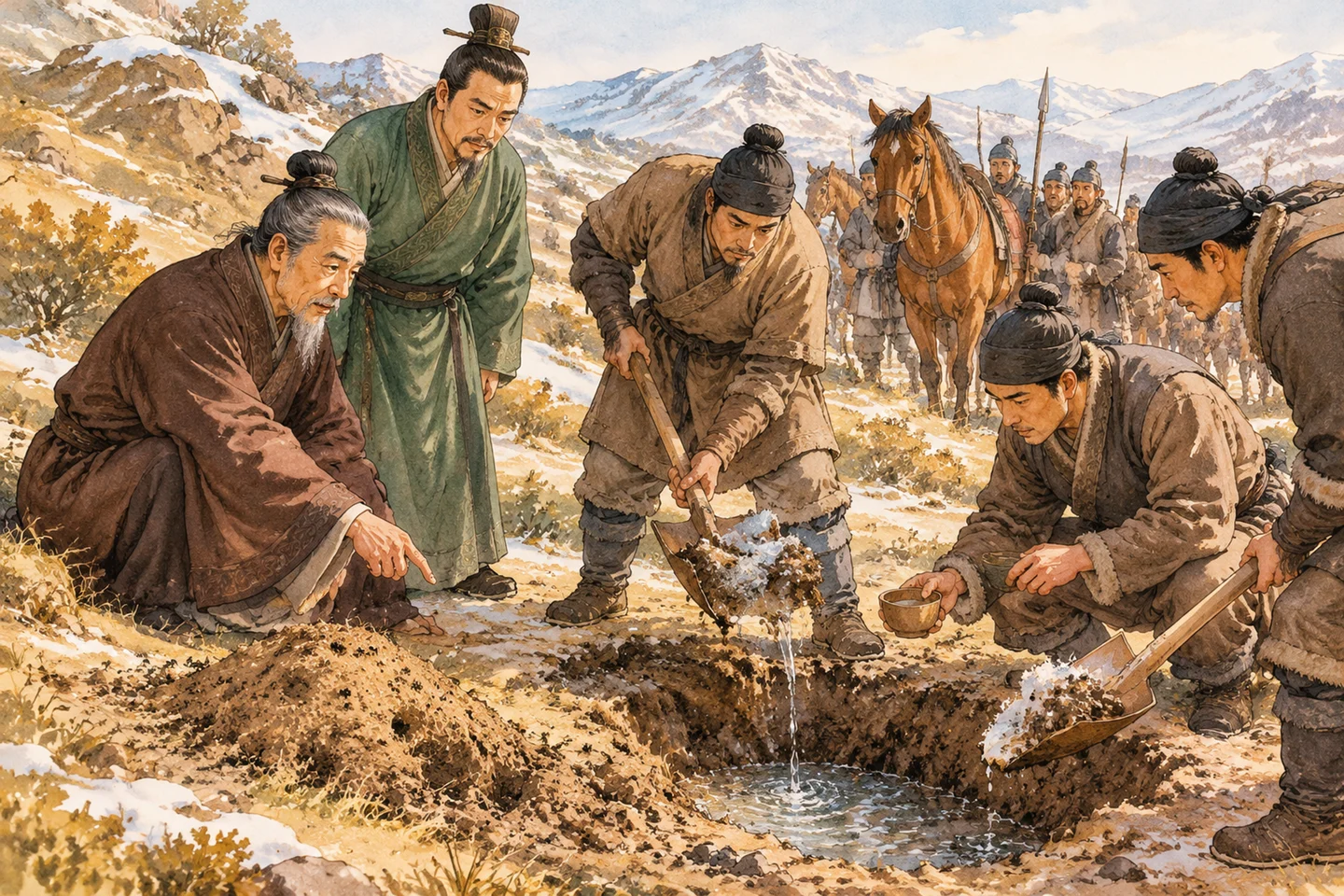
The army cheered. Bowls of water were passed from hand to hand. That night, no one beside the campfires spoke of mountain spirits.
Returning to Qi
By the time the army left the mountains, winter had arrived.
The campaign took place in 663 BCE. Qi had driven the Shanrong away from Yan, quieting the northern frontier for a time. As the army returned, Yan's ruler escorted the duke so far that he crossed into Qi's territory.
The duke said, “When rulers see a guest off, they should not pass their own borders. I cannot let you break the proper ceremony.”
He immediately granted Yan the stretch of Qi land its ruler had traveled over. He also urged him to put his government in order and continue sending tribute to the Zhou king. As the news spread, other rulers praised Qi's duke for helping a weaker state without grasping for more land.
Back in Linzi, northeast of present-day Zibo, the duke remembered the old horses. He ordered that they be well fed and never sent into battle again. Someone asked why an animal deserved such treatment. The duke answered simply, “They saved the whole army.”
When Guan Zhong heard, he nodded. He knew that the greatest danger during their wandering had been fear, not the mountains. Once everyone panicked, all it took was one person willing to learn from an old horse or an ant to change the situation.
Later, lao ma shi tu—“the old horse knows the way”—became an idiom for an experienced person who understands how things work and can guide others when they are confused.
But the duke's elder adviser was growing older. Years later, Guan Zhong lay ill, and the duke came to see him. He asked a difficult question: among all his officials, who could take Guan Zhong's place? Guan Zhong was silent for a long time.