Dynasty Tales
The Overlord Is Gone
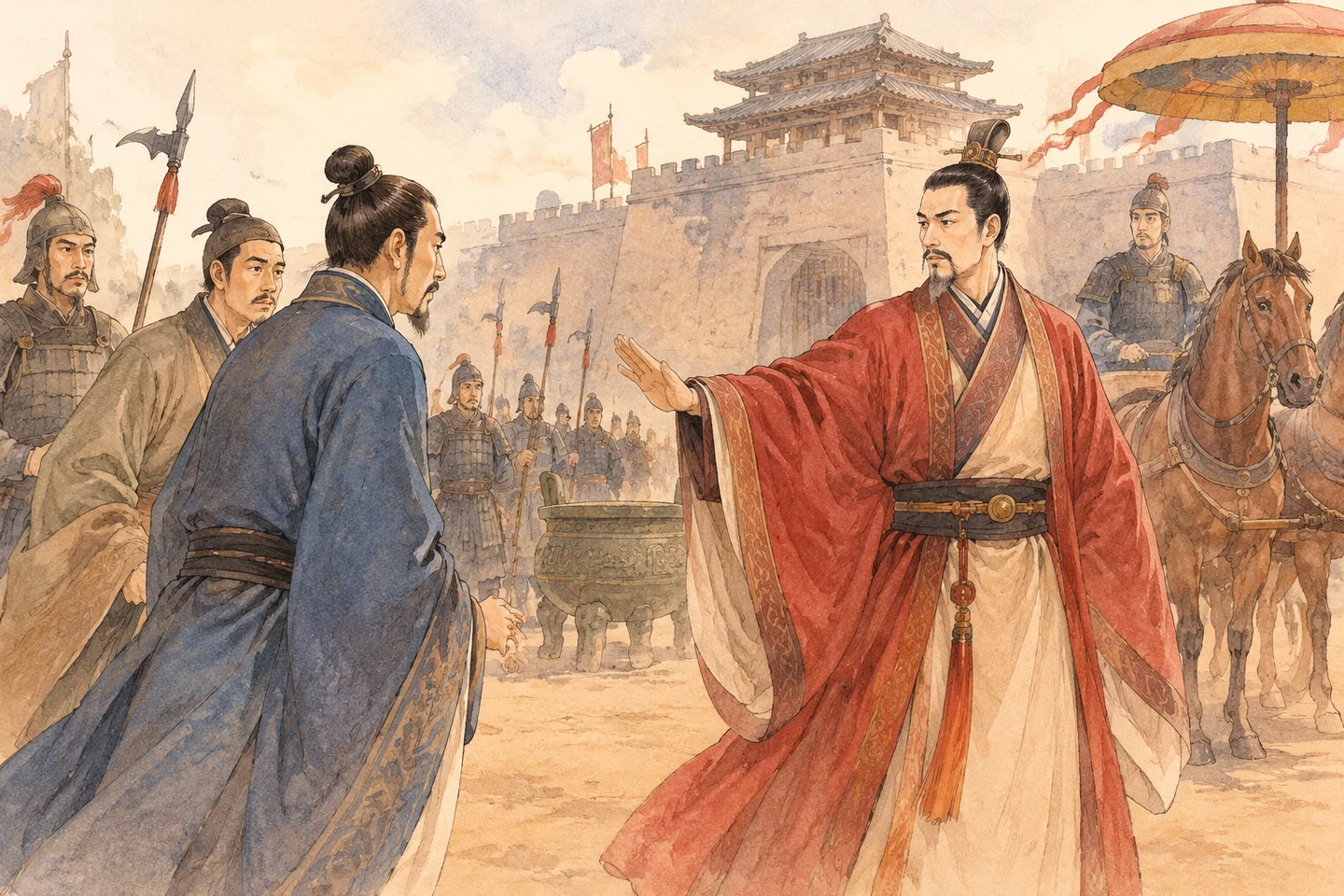
By the seventh century BCE, the Zhou king no longer ruled all the states in practice. After King Ping moved the royal court east in 770 BCE, the royal house grew weaker as the regional rulers grew stronger. The strongest could call the other states together and give orders. Such a ruler was called an overlord.
The first was Duke Huan of Qi. When he died in 643 BCE, fighting broke out within Qi, leaving no one able to hold the central states together. Chu, to the south, seized its chance to advance north. Smaller states such as Zheng, Song, Chen, and Cai were caught between powers, watching one side one day and the other the next.
A new overlord was needed. Two states could compete for the position: Chu in the south and Jin in the north.
Jin lay in what is now southern Shanxi. Its ruling family shared the Zhou royal surname, and its lands and army were substantial. But Jin had a long-standing problem: conflict within the ruling house. An ancestor of Duke Xian had won the throne through civil war. Duke Xian therefore watched his own sons with particular suspicion.
To understand how Chong’er became that rival, we must go back to the years before Duke Huan died.
Li Ji's Plot
Duke Xian had several sons. The crown prince, Shensheng, was an honorable man. Two other sons, Chong'er and Yiwu, were also capable. Chong'er would later become Duke Wen of Jin.
In his later years, Duke Xian favored Li Ji. She had a son, Xiqi, and wanted him to become ruler. But with a crown prince already in place, how could Xiqi inherit the throne?
At first, she whispered accusations against Shensheng. Then she went further. She put poison into sacrificial meat he had sent to his father and accused him of trying to kill the duke. Duke Xian believed her.
Shensheng could find no way to defend himself. Someone urged him to flee, but he shook his head. If he left, he said, there would be no one to look after his father. He would neither run nor argue his case. In the end, he took his own life.
After the crown prince died, Li Ji turned on Chong'er and Yiwu. She told the duke that they had known about Shensheng's supposed plot. Furious, Duke Xian sent men to seize them.
Over the Wall and into Exile
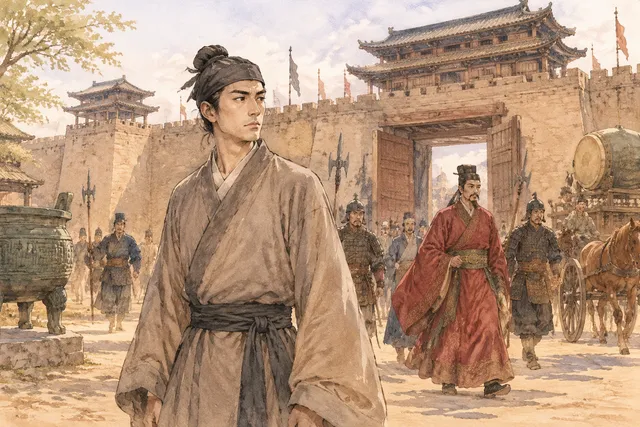
Chong'er was then stationed at Pu, near present-day Xi County in Shanxi. When the attackers arrived, he turned and scrambled over a wall. A sword swung behind him, cutting off part of his sleeve but missing his body.
His escape would become nineteen years of exile.
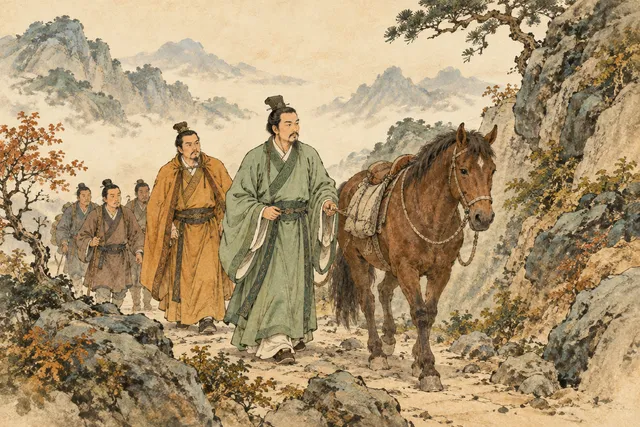
A few skilled men went with him: his uncle Hu Yan, Zhao Cui, Xu Chen, Wei Chou, and Jie Zitui. They were not many, but each had abilities Chong'er would need if he ever returned to power.
First they fled to the Di people, in what is now northern Shanxi. Chong'er's mother had come from there. The Di received him, and he stayed for many years.
Duke Xian died in 651 BCE. Jin fell into turmoil as princes competed for the throne. With help from Qin, Yiwu finally became ruler, known as Duke Hui of Jin.
Once secure, Duke Hui thought first about his surviving older brother rather than governing. He sent assassins to Di to kill Chong'er.
When the warning arrived, Chong'er dared not stay. Hu Yan said Di was too small to help him achieve much. Qi, the overlord's state, offered a better hope.
They packed and set off. Their first stop was Wei, but Duke Wen of Wei would not even open the city gates. The travelers were left outside, hungry.
The cold welcomes of exile had only begun.
A Clod of Earth at Wulu
Unable to enter Wei, they continued east. By Wulu, near the present-day border of Henan and Hebei, their food was gone. Dizzy with hunger, Chong'er saw a farmer eating beside a field and asked him for something to eat.
The farmer looked over the ragged travelers. Without a word, he bent down, picked up a clod of earth, and offered it.
Chong'er turned pale with anger and raised his whip. Hu Yan stopped him. Smiling, he called it a good sign: the common people were placing land in the prince's hands. Heaven was giving him a state.
Chong'er paused, lowered his head, and accepted the clod. He carefully placed it in the cart. They left Wulu still hungry, but Hu Yan's explanation gave them a little hope as they traveled onward.
Too Comfortable in Qi
Ahead lay Qi. In its capital, Linzi, near present-day Zibo in Shandong, the aging Duke Huan welcomed Chong'er generously. He married a woman of the ruling family, Qi Jiang, to the prince and gave him horses and carriages.
Before long, however, Duke Huan died. Qi's princes fought over the throne, and no one had time to send an army to help a prince from another state.
Chong'er grew comfortable. He had a wife, transport, and plenty to eat and drink. After years of hardship, he could rest at last. He said people wanted ease in life, so why keep risking everything? He intended to grow old and die in Qi.
His companions were alarmed. Hu Yan, Zhao Cui, and the others met under a mulberry tree. If the prince stayed, what had all their years of hardship been for? Qi Jiang understood too. She reminded Chong'er of his ambition and urged him not to let affection keep him from it. He refused to listen.
Qi Jiang and Hu Yan joined forces. At a feast, they got Chong'er thoroughly drunk. His companions lifted him into a carriage and left the city during the night.
When he woke the next morning and found himself on the road, Chong'er was furious. He seized a long dagger-axe and chased Hu Yan, shouting that if the plan failed, he would eat his flesh.
Hu Yan dodged as he answered. If the plan succeeded, being killed would be worth it. If it failed, his flesh would smell so bad that the prince would hardly want to eat it.
As Chong'er chased him, his anger faded. At last he laughed. He accepted that this was the road he would follow.
Cold Welcomes and a Feast in Chu
The journey ahead was still difficult.
In Cao, Duke Gong heard that Chong'er's ribs were unusual. He hid behind a curtain to watch him bathe. An official named Xi Fuji had a wife who saw something else. Chong'er's attendants, she told her husband, were men who could each govern a state. With such help, the prince might one day rise to power. Now was the time to show kindness. Xi Fuji quietly sent food, with a jade disk underneath. Chong'er accepted the food and returned the jade.
In Song, Duke Xiang had recently lost to Chu at Hongshui, near present-day Zhecheng in Henan. That battle had taken place in 638 BCE, and his wounds had not healed. He nevertheless received Chong'er with the honors due to a ruler and gave him generous gifts. He admitted that Song, newly defeated, could not help him regain his state.
In Zheng, Duke Wen was distant and would not give Chong'er a proper welcome.
After repeated disappointments, Chong'er and his companions finally turned south to Chu. Chu had broad lands and powerful troops and was competing with Jin for influence over the central states.
King Cheng of Chu welcomed him with the ceremonies used between rulers and held a feast. After several rounds of wine, the king half jokingly asked what Chong'er would give him in return if he ever went home to Jin.
Chong'er considered his answer and spoke with dignity. The king already had gold, silver, jade, and silk, he said. Chu produced feathers and leather itself. He could think of nothing suitable to offer.
The king pressed him. Even so, surely he could make some promise?
After a moment, Chong'er replied that if the king's help allowed him to return to Jin, and Jin and Chu later met in battle in the central lands, he would first retreat three she. If the king still would not withdraw, then they would fight. A she was a marching distance of thirty li; three she meant ninety li.
The guests fell silent. The king nodded and asked no more. But one man at the feast looked displeased.
Chu's chief minister, Ziyu, leaned toward the king. The king had treated this man so well, he whispered, yet the prince spoke boldly. His followers were all suited to high command. Unless they dealt with him, he would become a serious threat to Chu.
The king held his wine cup and said nothing for a long time.
Chu Lets Him Go; Qin Helps Him Home
King Cheng did not follow Ziyu's advice. He told his attendants that the prince had great ambition and loyal companions. Heaven seemed to favor him. Killing him would mean opposing Heaven.
Instead of killing Chong'er, the king sent him and his companions west to Qin.
Duke Mu of Qin wanted a ruler in Jin who would listen to him. He married several women of his ruling family to Chong'er and sent troops to escort him east. In 636 BCE, the army reached the Yellow River.
Before they crossed, Hu Yan held out a jade disk. Quietly, he said that he knew he had made many mistakes during their years together. He asked to remain behind and say farewell.
Chong'er caught his hand. If he did not stand together with his uncle, he said, let the clear river bear witness. He threw the jade disk into the rushing Yellow River.
Across the river, Jin's old officials began supporting Chong'er, and Duke Huai fled. Chong'er entered Jiang, near present-day Yicheng in Shanxi, and took the throne as Duke Wen of Jin. He had spent nineteen years away.
Once home, Duke Wen settled affairs within the state. He rewarded those who had served him, chose capable officials, reduced taxes, and trained his forces. Jin grew stronger day by day.
Song Calls for Help
In 633 BCE, Chu led forces from Chen, Cai, Zheng, and Xu to surround Song's capital. Song had treated Chong'er kindly during his exile. Now it sent urgently to Jin for help.
Duke Wen faced a difficult choice. Refusing would betray Song's kindness. Helping would bring Jin into direct conflict with Chu—and he still remembered his promise to retreat three she.
The general Xian Zhen proposed a plan. Cao and Wei were Chu's allies. If Jin attacked them, Chu would have to turn back to help, lifting the siege of Song.
Jin's army marched east and captured Wulu in Wei. The place where Chong'er had once begged for food became his army's camp. Next, Jin entered Cao's capital and captured Duke Gong. Duke Wen remembered the humiliation of being watched as he bathed. He also remembered Xi Fuji's meal, and ordered his troops to leave Xi Fuji's household unharmed.
King Cheng recognized Jin's strength and told Ziyu to withdraw. Ziyu refused. Instead, he moved his army north and pursued Jin's forces.
Retreating Three She
Some men in Jin's army objected. For a ruler to retreat before another state's minister, they felt, was deeply humiliating.
Hu Yan disagreed. A war needed a just reason, he said. Chong'er had accepted King Cheng's kindness and had to keep his promise. If Jin withdrew and Chu still pursued, Chu would be in the wrong.
Duke Wen nodded and gave the order. Jin's army withdrew ninety li to Chengpu, southwest of present-day Juancheng in Shandong.
Ziyu would not stop. His army advanced, and the two sides formed up at Chengpu in the fourth month of 632 BCE.
Jin attacked in several ways. Xu Chen covered his horses with tiger skins and charged Chu's right wing. Chu's horses panicked and turned, breaking that wing apart. Hu Mao raised two large flags and pretended to retreat. Luan Zhi had branches dragged behind chariots, raising clouds of dust to suggest a fleeing army. Chu's left wing chased eagerly. Then Xian Zhen's central force cut across its path, while Hu Mao and Hu Yan attacked from the sides. Chu's left wing collapsed too.
Ziyu saw the danger, kept his central force together, and withdrew. Jin had won.
In the fifth month of the same year, Duke Wen met other rulers at Jiantu, southwest of present-day Yuanyang in Henan. King Xiang of Zhou formally appointed him leader of the regional lords. Jin replaced Qi as the leading power among the central states.
Ziyu could not bear to face the king of Chu after his defeat. He took his own life.
A clod of earth, a drunken departure, a promise made at a feast: the nineteen-year journey had led to Chengpu. Yet new trouble soon followed. In 630 BCE, Duke Wen joined Qin in surrounding Zheng. Zheng's ruler was alarmed. One night, a gray-haired man was quietly lowered from the city wall on a rope. He headed straight for Qin's camp to meet Duke Mu.